Where torch & pole are keys to worlds that defy all logic. And boy is it fun!
I will be the first to admit that I have never really understood the appeal of the Megadungeon. I just didn’t get it. It seemed boring and uninteresting to me, a relic of an older style of play. But once I got a chance to taste one, boy was I in for an awakening.
This prompted me to start looking into Megadungeons, which eventually brought me to a fine piece of writing on just such a topic.
Reading Jason Cone’s “The Dungeon as Mythic Underworld” in his seminal Philotomy’s Musings, A collection of interpretations, house rulings, expansions, and general pontification on the nature of the Original Dungeons & Dragons rules by Gary Gygax and Dave Arneson. This 49-page PDF of wonder is the main reason I got excited about running a Megadungeon.
If you don’t already have a copy of the PDF of Philotomy’s Musings, you can download a free version here, in a nice-looking OD&D style layout put together by Jason Vey.
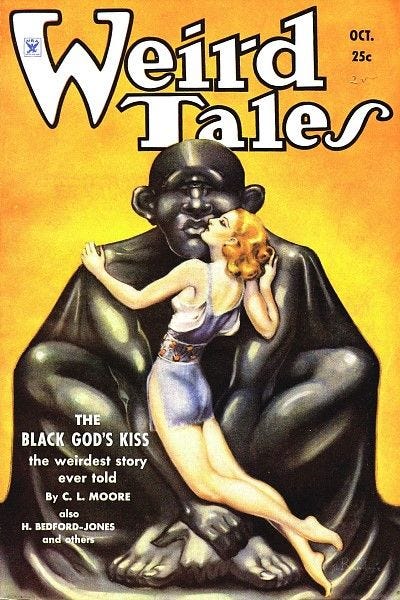
For a fantastic short read that really epitomizes the Dungeon as Mythic Underworld, I highly recommend checking out The Black Gods Kiss by C.L Moore.
“Black God’s Kiss” is the first of C. L. Moore’s Jirel of Joiry stories, written in 1934. It features a red-headed French swords-woman named Jirel of Joiry, who is no mere bikini-armored barbarian, but a warrior of her faith who must travel to the depths of a hellish dimension to seek out a terrible weapon from a dark, alien dimension beneath her castle to defeat Guillaume, her kingdom’s conqueror. Descending into the unsettling depths, she encounters a sinister, ancient power and is compelled to accept its dark kiss, a curse that will grant her the power to slay Guillaume but at a cost to her soul and sanity.
Black Gods Kiss ushers it’s reader into a world of amphibious grotesqueries, nightmarish geometries, lakes of uncanny beauty, mysterious temples, and the terrible “squatting Black God” that wants your humanity in exchange for a kiss.
Sound good? Like a two headed sexy Troll in heat, willing to by me a drink, it certainly had me enthralled.
.~ I share here for you a great excerpt from the sublime pages of Philotomy’s Musings.~
THE DUNGEON AS A MYTHIC UNDERWORLD
There are many interpretations of “the dungeon” in D&D. OD&D, in particular, lends itself to a certain type of dungeon that is often called a “megadungeon” and that I usually refer to as “the underworld.” There is a school of thought on dungeons that says they should have been built with a distinct purpose, should “make sense” as far as the inhabitants and their ecology, and shouldn’t necessarily be the centrepiece of the game (after all, the Mines of Moria were just a place to get through). None of that need be true for a megadungeon underworld. There might be a reason the dungeon exists, but there might not; it might simply be. It certainly can, and perhaps should, be the centerpiece of the game. As for ecology, a megadungeon should have a certain amount of verisimilitude and internal consistency, but it is an underworld: a place where the normal laws of reality may not apply, and may be bent, warped, or broken. Not merely an underground site or a lair, not sane, the underworld gnaws on the physical world like some chaotic cancer. It is inimical to men; the dungeon, itself, opposes and obstructs the adventurers brave enough to explore it. For example, consider the OD&D approach to doors and to vision in the underworld:There is so much more to learn and appreciate within the pages of this PDF. I highly recommend giving it a read, in fact I couldn’t recommend it more. So many treasures that are sure to enhance your dungeon experience.
Generally, doors will not open by turning the handle or by a push. Doors must be forced open by strength…Most doors will automatically close, despite the difficulty in opening them. Doors will automatically open for monsters, unless they are held shut against them by characters. Doors can be wedged open by means of spikes, but there is a one-third chance (die 5-6) that the spike will slip and the door will shut…In the underworld some light source or an infravision spell must be used. Torches, lanterns, and magic swords will illuminate the way, but they also allow monsters to “see” the users so that monsters will never be surprised unless coming through a door. Also, torches can be blown out by a strong gust of wind. Monsters are assumed to have permanent infravision as long as they are not serving some character. (The Underworld & Wilderness Adventures, pg 9)
Special Ability functions are generally as indicated in CHAINMAIL where not contradictory to the information stated hereinafter, and it is generally true that any monster or man can see in total darkness as far as the dungeons are concerned except player characters. (Monsters & Treasure, pg 5)
Notice that all characters, including those which can see in normal darkness (e.g. elves, dwarves), require a light source in the underworld, while all denizens of the place possess infravision or the ability to see in total darkness. Even more telling, a monster that enters the service of a character loses this special vision. Similarly, characters must force their way through doors and have difficulty keeping them open; however, these same doors automatically open for monsters. This is a clear example of how the normal rules do not apply to the underworld, and how the underworld, itself, works against the characters exploring it.
Of course, none of this demands that every dungeon need be a mythic underworld; there could be natural caves and delved dungeon sites that are not in the “underworld” category, and follow more natural laws. Nevertheless, the central dungeon of the campaign benefits from the strange other-worldliness that characterizes a mythic underworld.
A mythic underworld should not be confused with the concept of the “underdark.” The underdark concept is that of an underground wilderness composed of miles of caves, tunnels, delved sites, and even whole underground cities. This is a cool fantasy concept, but is distinct from the concept of a mythic underworld that obeys its own laws and is weird, otherworldly, and apart from the natural order of things. (There is no reason a referee couldn’t join the two concepts of underworld and underdark, though.)
Some common characteristics and philosophies for a mythic underworld or megadungeon (keep these in mind when creating your dungeon):
- It’s big, and has many levels; in fact, it may be endless
- It follows its own ecological and physical rules
- It is not static; the inhabitants and even the layout may grow or change over time
- It is not linear; there are many possible paths and interconnections
- There are many ways to move up and down through the levels.
- Its purpose is mysterious or shrouded in legend
- It’s inimical to those exploring it
- Deeper or farther levels are more dangerous
- It’s a (the?) central feature of the campaignThere is so much more to learn and appreciate within the pages of this PDF. I highly recommend giving it a read, in fact I couldn’t recommend it more. So many treasures that are sure to enhance your dungeon experience.


No comments:
Post a Comment